23
Another Late-Acknowledged Death in ICE Custody makes FY25 2nd Deadliest on Record; and a new look at what we lose when CRCL shuts down

Imperial Seizure
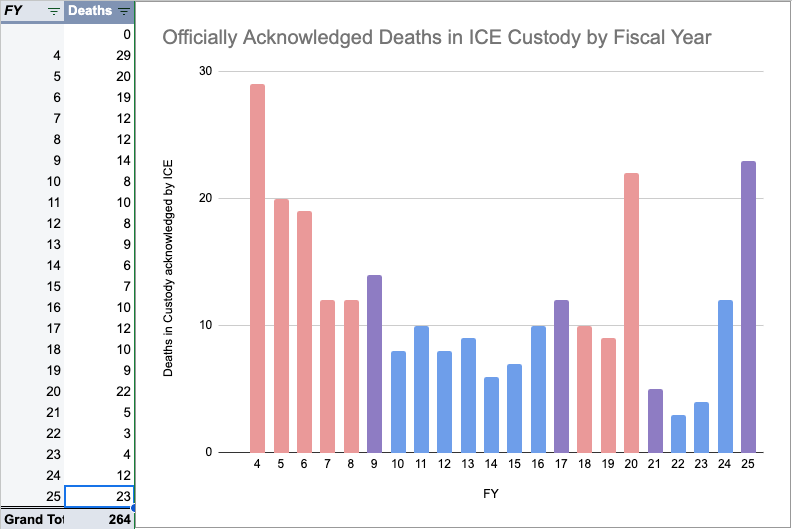
Chinese national Huabing Xie died in ICE custody on September 29 following a short detention at the Imperial Regional Detention Facility in Calexico, California, according to an announcement the agency posted Friday. His death raises to 23 the officially acknowledged total number of deaths in ICE detention during Fiscal Year 2025—surpassing all other fiscal years on record but one.
We do not know how old Huabing Xie was. That’s because, in a break from prior practice, ICE doesn’t disclose this fact in its press release. ICE says facility staff responded to what appeared to be a seizure, followed by Xie becoming unresponsive, at 2:13 p.m. He was pronounced dead a little over an hour later at a nearby hospital.
We know Xie originally arrived in the U.S. on December 31, 2023, when Border Patrol agents arrested him near Tecate, California, served him with a notice to appear in immigration court, and released him on recognizance. Fast forward less than two years to September 12, when Border Patrol arrested him again, this time in Indio, California. It is at once unclear and unmistakable what changed between his release on New Year’s Eve 2023 and his rearrest on September 12, 2025.
By my count, Xie is at least the AAPI third person to die in ICE custody after being rearrested without any intervening legal or factual change in their immigration case. He joins Nhon Ngoc Nguyen and Tien Xuan Phan on the list of people the agency previously allowed to live free in the U.S. before recapturing them under a new push for detention bed space and detaining them until their death.
ICE’s Office of Detention Oversight (ODO) cited Management and Training Corporation - Imperial’s operator - for violating medical care standards in a January 2025 compliance inspection because it did not have adequate medical interpretation services. This “area of concern” delayed medical intake and caused MTC to lock individuals from Togo, Ghana, India, and Pakistan in cells by themselves as a precautionary measure. Yet ICE’s press release — like all before it — falsely assures the public and lawmakers that “all people in ICE custody receive medical, dental and mental health intake screening within 12 hours of arriving at each detention facility.”
ICE’s Health Service Corps completes mortality review in the wake of deaths in detention which, as we have documented exhaustively, find delays and violations in detention contractors’ delivery of medical care. ICE’s press release thus violates the Information Quality Act—an issue we’ll be addressing in FY26.
How did a man who managed to survive in the free world for 622 days pass away after just 18 in DHS custody? We will have to wait to find out.
CRCL and Prairieland
Many lifetimes ago, last March, DHS leadership gutted the statutorily required Office for Civil Rights and Civil Liberties. At the time, former CRCL head Margo Schlanger described the office to Bloomberg’s Ellen Gilmer as a “fire alarm function” that could prevent serious harms and legal violations. Whistleblowers represented by the able folks at the Government Accountability Project raised the alarm about potential consequences of that decision.
Today, National Immigration Law Center’s Jen Ibanez Whitlock tells NPR’s Ximena Bustillo1 detained immigrants begin sucked into the $45 billion ICE detention dragnet have nowhere to turn without CRCL. One former official puts it bluntly:
“More people are going to die in custody as a result because there are not going to be the same level of checks and balances internally. And the American public will not be able to be as outraged because there’s no one with whom to file these complaints.”
A recent release obtained through FOIA litigation brought by the family members of people who died in ICE custody helpfully illustrates this point. Gourgen Mirimanian passed away at ICE’s Prairieland Detention Center, operated for-profit by the McConnell family-owned LaSalle Corrections, in Alvarado, Texas. His son Mike sought records about his death after being told by an attending physician that had his father been afforded the outpatient cardiac care LaSalle cancelled, the arterial blockages that caused his heart attack would have been immediately diagnosed and treated.
CRCL later inspected Prairieland in response to complaints about Gourgen’s death and that of Maria Celeste Ochoa Yoc de Ramirez, both of whom are discussed in the Deadly Failures report published last summer by ACLU, American Oversight, and Physicians for Human rights. After three years of litigation, and a declaratory judgment that ICE has an unlawful pattern and practice of failing to follow FOIA’s timing provisions, forcing families who lose loved ones in custody to sue the agency for information, Mike obtained CRCL’s report on Prairieland.
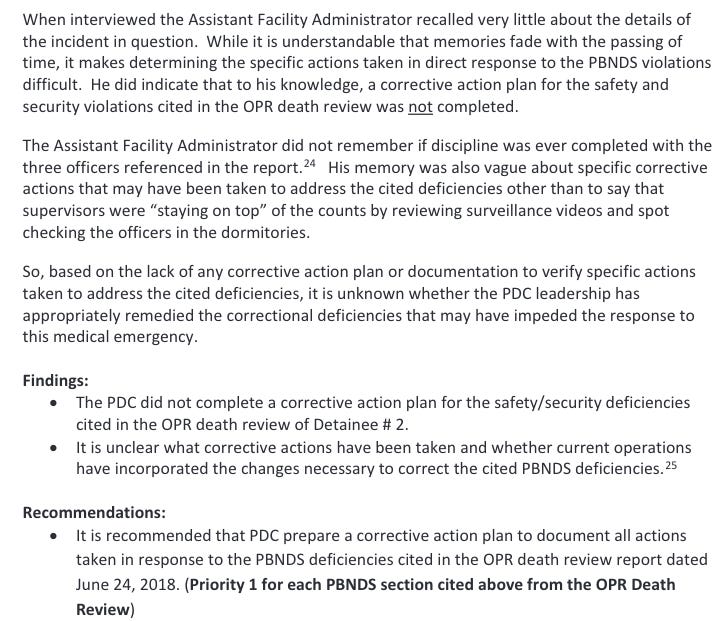
CRCL’s expert investigators’ report reveals what many suspect: Facility staff are basically unaware of the agency’s findings in past death investigations, and ICE fails to require and enforce Corrective Action Plans that could prevent future tragedies. While medical staff corrected the LaSalle Keep on Person (KOP) medication policy that made it impossible to explain why an unprescribed controlled substance ended up in Gourgen’s toxicology results, facility security staff informed CRCL’s experts it had basically no recollection of any corrective action plan, any policy violation findings by ICE, or any need for changed practices:
In reviewing the full 55-page FOIA record of CRCL’s oversight at Prairieland, we find a mostly supportive, largely laudatory account of operations there by the contracted experts. They go out of their way to note where PDC medical and security staff follow the rules, and largely discount or cast aside evidence to the contrary, which is generally presented by detained immigrants.
These inspections are vitally important and probably saved lives. It is unclear how they could be “hindering the Department’s mission of securing the homeland,” as DHS spox McLaughlin implied to NPR. In their absence, former CRCL employees, immigration attorneys and advocates are correct to wonder who’s going to perform these vital tasks.
I highly recommend reading Bustillo’s entire piece, which thoroughly lays out the scope and stakes of CRCL’s effective shutdown by de-staffing. One comes away from the piece with a firm conviction that the absence of these professionals looking out for compliance in the places DHS detains people means more people are likely to die from preventable systems failures CRCL would normally detect. We’re already seeing it, as this year’s 23 acknowledged deaths in detention make clear.