Updates
On responding with clarity and calm to current events

January 15, 2026
A reminder that we’ve got our FOIA Friday public call at 2pm east / 11 am pacific tomorrow. Here’s the link: www.tinyurl.com/FOIAFridayCall.
This week, we’ll share FOI wins and talk attorney fees in FOI litigation. I’ll present a draft of a multi-year study I’ve been doing based on DOJ’s FOIA Litigation Reports that analyzes recovery trends, amounts, etc. If you’re thinking about some some / some moreFOIA lawyering, you belong here.
New Report Release Date: February 5
An onslaught of deeply troubling, potentially history-altering violent events has unfolded before our eyes, on our streets, inside DHS detention spaces, in court, and in the world since I provided the last ETA on the 2025 Death in Custody Report. I’ve been working this report September, aiming to make it a first draft that people can model and use in the coming years, as the scale of the problem expands—likely exponentially. In thinking about how to accomplish these aims, I have bumped the target date for releasing the report multiple times. These delays stem from a genuine effort to make its contents as usable and timely as I can, while capturing this moment in a way that’s durable and legible for future generations. Something that stands the test of time.
Anger can be a useful teacher, but it’s a horrible master. Right now, seeing the chain of events that’s led to our present laid out in this report, and then looking ahead into the not-at-all distant future, it is all too easy to be consumed by anger. That is not the driving force I intend to put into this work—which is unpaid and undertaken largely as a labor of love. Anyone can be mad about injustice. Addressing it requires love, and the expansive perspective it can bring to how we’re relating to one another.
So, I’m taking some additional time to rewrite some of the front matter from a place of love for the future generations who might find it, rather than a place of anger and hate for the conditions we’re seeing. That delay will also allow finalization of a much more sophisticated and authoritative public-facing database so that researchers, journalists, movement actors, historians, and stakeholders can see and sift the data for themselves, and find new pathways to impacting the space.
I appreciate your patience and forbearance as I continue trying to take some space to be human while doing what the moment demands.
Now, some odds and ends.
ICE Visits Social Circle, GA Human Warehouse
On Christmas Eve, the Washington Post broke the the most concrete details yet about an ICE plan, previously reported in the abstract by NBC, to create a nationwide detention warehouse network of “mega-hubs” that will allow the deportation system to fulfill ICE Acting Director Todd Lyons’ aspiration of having the agency run like Amazon “Prime, but for human beings.”
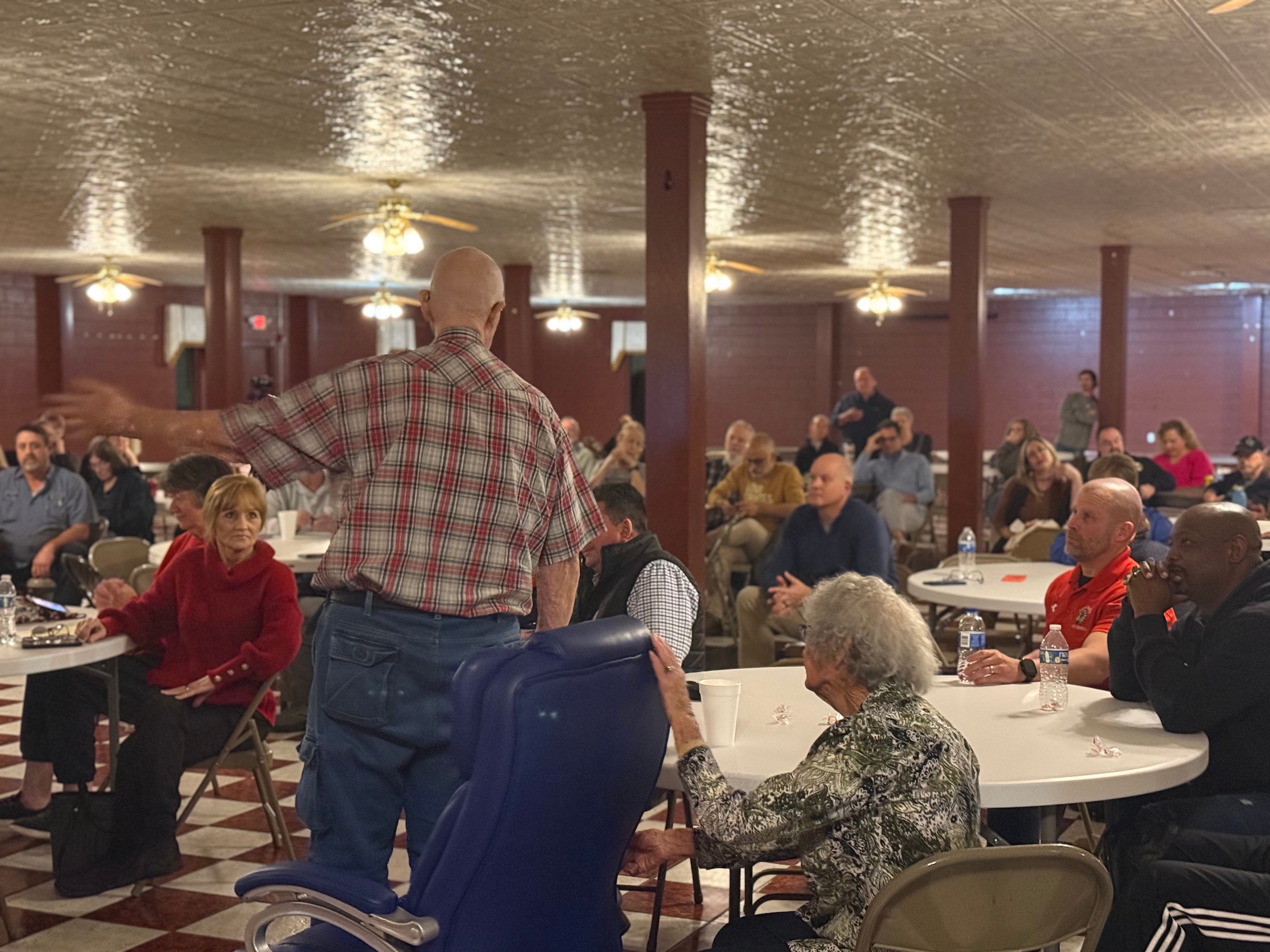
Last week I got to cover a meeting of residents and officials in Social Circle, Georgia—site of one of the million-square-foot buildings ICE’s plan identifies, per WaPo. As I wrote in my story for the Atlanta Community Press Collective, nobody in Social Circle — a tiny town of 5,400 residents — wants this place in their backyard.
Undeterred, ICE and its secret contractor, the Russian-backed PNK Group, conducted a site visit to the newly constructed warehouse less than 4,000 feet from the newly constructed elementary school that opened last fall. Members of Indivisible and other community organizations showed up to voice their opposition.
The message is simple: they’re coming. Whether you like it or not. Whether you’re politically favored or not. Whether you oppose them in an organized way or not.
For me, the most haunting part of the affair is the location of the warehouse near a train track in an industrial area. The visuals are simply too on the nose if you’ve read any history, and are now reading the words and images they’re sending out font DHS is using, the message on the DHS spox’s podium, or the white nationalist mass murderer-quoted anthem they’re quoting.
A lot of us have grandparents who killed Nazis and got medals for it. Now pointing out the federal government is lousy with Nazis makes you liable to be labeled a “terrorist” under NSPM-7.
The Order of the Day
Speaking of disgusting Nazis cloaked as high-flying businessmen . . .

Here is an excerpt from the very beginning of a book I read once or twice a year. It’s so, so well-written, stark, and evocative:
A SECRET MEETING
The sun is a cold star. Its heart, spines of ice. Its light, unforgiving. In February, the trees are dead, the river petrified, as if the springs had stopped spewing water and the sea could swallow no more. Time stands still. In the morning, not a sound, not even birdsong. Then an automobile, and another, and suddenly footsteps, unseen silhouettes. The play is about to begin, but the curtain won’t rise.
It’s Monday. The city is just beginning to stir behind its scrim of fog. People go to work as on any other day; they board the bus or trolley, thread their way onto the upper deck, then daydream in the chill. And even though the twentieth of February 1933 was not just any other day, most people spent the morning grinding away, immersed in the great, decent fallacy of work, with its small gestures that enfold a silent, conventional truth and reduce the entire epic of our lives to a diligent pantomime. The day passed, quiet and normal. And while everyone shuttled between house and factory, market and courtyard where the laundry is hung out to dry, or in the evening between office and tavern, before finally heading home—far away, far from the decent labors, far from domestic life, on the banks of the Spree, some men got out of their cars in front of a palace. Through doors obsequiously held open, they stepped from their huge black sedans and paraded in single file, dwarfed by the heavy sandstone columns. There were twenty-four of them, near the dead trees on the bank: twenty-four overcoats in black, brown, or amber; twenty-four pairs of wool-padded shoulders; twenty-four three-piece suits, and the same number of pleated trousers with wide cuffs. The shadows entered the large vestibule of the palace of the President of the Assembly—though before long, there would be no more assembly, no more president, and eventually no more parliament. Only a heap of smoking rubble.
. . .
They listened. The basic idea was this: they had to put an end to a weak regime, ward off the Communist menace, eliminate trade unions, and allow every entrepreneur to be the führer of his own shop. The speech lasted half an hour. When Hitler had finished, Gustav stood up, took a step forward, and, on behalf of all those present, thanked him for having finally clarified the political situation. The chancellor made a quick lap around the table on his way out. They congratulated him courteously. The old industrialists seemed relieved. Once he had departed, Goering took the floor, energetically reformulating several ideas, then returned to the March 5 elections. This was a unique opportunity to break out of the impasse they were in. But to mount a successful campaign, they needed money; the Nazi Party didn’t have a blessed cent and Election Day was fast approaching. At that moment, Hjalmar Schacht rose to his feet, smiled at the assembly, and called out, “And now, gentlemen, time to pony up!”
Cavalier though it was, the invitation was hardly novel to these men, who were used to kickbacks and backhanders. Corruption is an irreducible line item in the budget of large companies, and it goes by several names: lobbying fees, gifts, political contributions. Most of the guests immediately handed over hundreds of thousands of marks. Gustav Krupp gave a million, Georg von Schnitzler four hundred thousand, and so they raked in a hefty sum. That meeting of February 20, which might seem to us a unique moment in corporate history, an unprecedented compromise with the Nazis, was in fact nothing more for the Krupps, Opels, and Siemenses than a perfectly ordinary business transaction, your basic fund-raising. All would survive the regime and go on to finance many other parties, commensurate with their level of performance. But to truly understand the meeting of February 20, 1933, to grasp its everlasting import, we must now call these men by their real names. It was not Günther Quandt, Wilhelm von Opel, Gustav Krupp, and August von Finck who were present that late afternoon, in the palace of the President of the Reichstag. We must use other designations. For “Günther Quandt” is a cryptonym; it masks something very different from the corpulent gentleman slicking down his mustache and sitting quietly in his seat around the table of honor. Close behind him is a rather more imposing silhouette, a tutelary shadow, as cold and impervious as a stone statue. Yes, hovering in all its fierce, anonymous power above Quandt and making him look stiff as a mask (but a mask that fits his face more closely than his own skin), we can see Accumulatoren-Fabrik AG, later called Varta—for as we know, legal entities have their avatars, just as ancient divinities took various forms and occasionally absorbed other divinities.
This, then, is the Quandts’ real name, their demigod identity; whereas he, Günther, is but a tiny little mound of skin and bone like you and me. When he’s gone, his sons will sit on the throne, then the sons of his sons. But the throne itself remains, even after the little mound of skin and bone has curdled in the earth. As such, these twenty-four men are not called Schnitzler, or Witzleben, or Schmitt, or Finck, or Rosterg, or Heubel, as their identity papers would have us believe. They are called BASF, Bayer, Agfa, Opel, IG Farben, Siemens, Allianz, Telefunken. By these names we shall know them. In fact, we know them very well. They are here beside us, among us. They are our cars, our washing machines, our household appliances, our clock radios, our homeowner’s insurance, our watch batteries. They are here, there, and everywhere, in all sorts of guises. Our daily life is theirs. They care for us, clothe us, light our way, carry us over the world’s highways, rock us to sleep. And the twenty-four gentlemen present at the palace of the President of the Reichstag that February 20 are none other than their proxies, the clergy of major industry; they are the high priests of Ptah. And there they stand, affectless, like twenty-four calculating machines at the gates of Hell.