He was alive
And other notable developments on the death beat

May 22, 2026
Happy FOIA Friday!
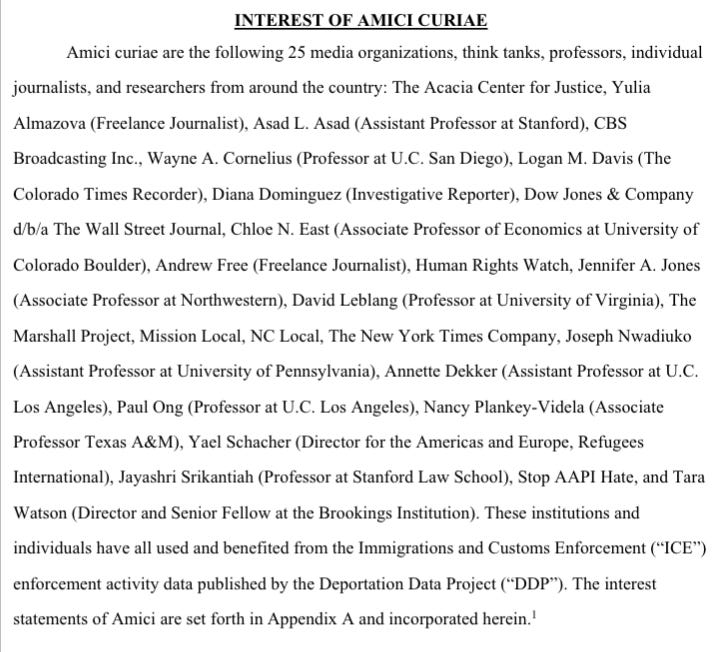
In the spirit of everyone’s favorite federal statute (FOIA), I am excited to share this absolute banger of an amicus brief. 25 civil society actors (myself included), represented by Lieff Cabraser, filed it earlier this week in support of the Deportation Data Project’s request for a preliminary injunction requiring ICE to affirmatively release spreadsheets we’ve used to inform the public about the realities of its activities. News outlets like The New York Times, CBS and the Wall Street Journal, local and independent journalists, academics, non-profit organizations, and practicing physicians all told the court how we lean on DDP data as an invaluable tool for cutting through the rhetoric and understanding What Our Government is Up To.
One thing I love about this brief is its situation of our FOIA right to timely access non-exempt government records as a foundational element of democratic participation:
Amici’s work serves a vital democratic function. In a functioning democracy, an informed electorate always inures to the public benefit. See Ctr. for Pub. Integrity v. United States Dep't of Def., 411 F. Supp. 3d 5, 15 (D.D.C. 2019). Importantly, it is often through journalists that the public receives important information about current events. Journalists act as “surrogates for the public.” Richmond Newspapers, Inc. et al. v. Commonwealth of Virginia, 448 U.S. 555, 573 (1980); see also Cox Broad. Corp. v. Cohn, 420 U.S. 469, 490-91 (1975) (“[I]n a society in which each individual has but limited time and resources with which to observe at first hand the operations of his government, he relies necessarily upon the press to bring to him in convenient form the facts of those operations.”). Further, journalists help explain information and provide valuable context to the public, and, typically, have increased visibility and access. “While media representatives enjoy the same right of access as the public, they often are provided special seating and priority of entry so that they may report what people in attendance have seen and heard.” Richmond Newspapers, 448 U.S. at 573.
We shouldn’t all have to FOIA the same things and wait until the stuff we FOIA isn’t news anymore to get them.
Then, the brief-writers explain how the knowledge production borne of information translates into real-world change, in near real-time:
Courts have also relied on facts developed using the Spreadsheets, including this Court’sdecision staying ICE’s policy of re-arresting and re-detaining noncitizens previously releasedfrom custody. Compl. ¶ 25; Mot. at 5 (citing Garro Pinchi v. Noem, 813 F. Supp. 3d 973, 996 n.8(N.D. Cal. 2025)). Local governments have likewise used the data to identify whether ICEactivity implicates local land use issues. Compl. ¶ 25; Mot. at 5. This is precisely the kind of government accountability that FOIA was enacted to facilitate . . .
Another thing I loved about reading it was learning how others are using the data. The Statements of Interest beginning on page 14 are a celebration of the creative power and ingenuity of human beings, working within our skillsets, just trying to do our part. ICE’s intransigence in FOIA—openly defiant of the statute—constrains this power to achieve its ends. Aggregation is the stuff of which victories are made. So here’s hoping June 18 brings one. We’ll all be better off as a result.
Deep gratitude to Amber Qureshi and all her amazing DDP collaborators for making this effort possible. Give them all the awards.
And let’s organize to replicate these efforts in other areas, k? Mkay.
Denny was Alive
ICE released the Detainee Death Report for Denny Adan Gonzalez, who died at Stewart on April 28, allegedly by suicide. In addition to officially acknowledging that no ambulance arrived until 11:01 p.m. - more than half an hour after CoreCivic guards allegedly found him hanging in his solitary confinement cell, ICE admits that at 10:31 p.m., five minutes after guards found him, Denny had a “thready pulse.” He was alive. Which means it’s possible they could have saved his life. I wrote about the structural delay in emergency care at Stewart for The Atlanta Community Press Collective. We featured a painful 911 audio recording where it took nearly two minutes for CoreCivic staff to even articulate the nature of the emergency to the 911 operator. But no ambulances were available in Stewart, because, despite making hundreds of millions of dollars for CoreCivic’s owners since it opened in 2006, the detention center has not managed to produce enough local revenue to equip the city of Lumpkin or Stewart County with sufficient ambulance resources to timely respond to emergencies.
Stewart County has around 5,000 residents. Then there’s the detention center, where, when you county staff and detained people, there are an additional ~2300 people in a single site on any given day. But they can only muster three ambulances, and they don’t all run at the same time. This is organized abandonment and premeditated budgetary manslaughter. Denny is simply the latest victim.
NBC Covers National 911 Data & Suicides
Denny’s case features in a thorough new report by NBC News on emergencies in ICE detention centers. The reporting team collected 911 records from the 16 largest ICE facilities around the country, analyzed them, and then connected the trends to the harms we’re seeing inside. It’s another essential read for the Death By Detention archive.
One thing that stands out in the piece, at least for our purposes here, is ICE continuing to fight the numbers by claiming there has been no spike in deaths. This is false; publications should identify it as such. Just because a flak gives you a quote does not mean it should be reprinted uncritically. Indeed, the lead author of the JAMA article conclusively disproving the ICE talking point is quoted in the NBC piece.
SF Chron Wins
If you haven’t read St. John Bernard Smith and Ko Lyn Cheang’s April 9 piece for the San Francisco Chronicle unpacking how medical neglect has driven up the numbers AND RATE of people dying in ICE detention, you should. It’s heartening to see the reporting team rewarded with the prestigious May Sidney award from the Hillman Foundation for their efforts.
Southwest Munchies
Finally, I want to once again flag the superb work of Sophia Qureshi and her team at 285 South, an independent media outlet in Atlanta, in covering the human costs and absurd stakes of the deportation regime.
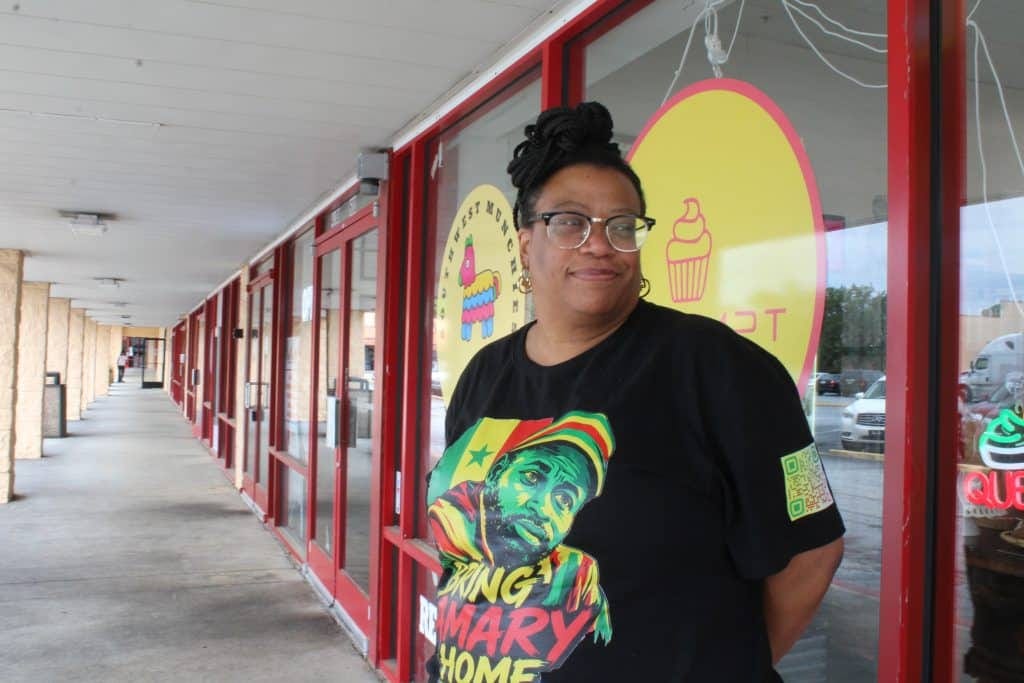
The story is about a family trying to feed a community in the era of mass deportation. Gail Saul opened Southwest Munchies with her husband Amary, an immigrant from Senegal. Amary’s confusion about which Atlanta Immigration Court to appear in, and his lack of a face mask needed to enter the building in 2022, meant he arrived minutes after being ordered removed in absentia. He immediately got a lawyer and filed a motion to reopen the deportation. The Board of Immigration Appeals has not ruled on it. But that didn’t stop ICE from arresting Amary in September and deporting him in January. Gail is now struggling to keep their dream of bringing delicious, nourishing food to a community alive while fighting to bring back her husband, with help from The Law Library and immigration detention contract ender Karim Golding, who helped shut down Etowah.
If you’re in Atlanta and need a snack or a caterer, Southwest Munchies is on Covington Road.
Thank you to all subscribers, free and paid. You make this work possible!