Escalating
ICE announces fourth death in detention in 10 days - 2nd in BOP facility in 2 years.

January 10, 2026

This evening the count of people ICE has acknowledging as dying in its custody rose to four, and the dehumanizing rhetoric rose with it.
In its post to the press page Saturday evening, ICE calls 46 year-old Cambodian immigrant Parady La a “career criminal.” What the agency buries is that the former lawful permanent resident who’s lived in the U.S. around age 1, in 1981, was in critical condition within 36 hours of his arrest on January 6, 2026.
According to the release:
Throughout the evening of Jan. 7, La remained in critical condition, with medical evaluations indicating limited brain function. The following day, Jan. 8, La was diagnosed with anoxic brain injury, post cardiac arrest, shock and multiple organ failures. He continued receiving care in the hospital’s Neuro Intensive Care Unit. Later that day, medical staff reported complete renal failure and no brain activity, and La was being fully supported by a respirator. Family members were notified and visited him at the hospital.
He was, ICE says, “receiving treatment” for “severe drug withdrawal” inside a cell at the Federal Detention Center in Philadelphia, which is a Bureau of Prisons site — not a hospital.
Don’t people who need treatment for severe drug withdrawal belong in hospitals? Not “administrative security federal detention.”
In May 2023, Kevante Washington was brutally raped and murdered at the facility. His family alleged in a suit filed in 2024 that he did not feel safe in the facility and its understaffing prevented them from protecting him.
La “we was found unresponsive in his cell.” - ICE’s explanation for how a man purportedly “receiving treatment for severe drug withdrawal” at a BOP facility ended up in the hospital prior to his death January 9, 2026
That’s when, on January 7, “he was found unresponsive in his cell.” Who found him? Was he not being monitored?
Mr. La’s family was able to visit him in the hospital before he expired in January 9.
ICE informs the public La became a green card holder in 1992, but “but lost his status after committing a long list of crimes over the course of two decades.” And despite providing dates and descriptions of ten interactions with the criminal punishment system (which is not ICE’s purview), we aren’t told whether he had a final order of removal (which is).
Was La in noticeable medical distress when he was apprehended? Was he cleared for detention by a medical provider? Was that provider acting within their scope of practice? If he’d been in a hospital or treatment center or out in the free world where he could have called an ambulance or gone to an E.D., instead of a prison facility, on January 6-7, would he have gotten care he needed?
It’s unclear if we’ll know anytime soon.
BOP Death Site Complicates Investigation
As I discussed following the June 2025 death Johnny Noviello—the first person in ICE custody at a BOP facility in more than a decade—ICE and BOP executed a memorandum of agreement in February allowing people civilly detained for immigration violations to be housed in prisons designed to punish folks convict of crimes. The provision for how deaths get investigating this MOA includes doesn’t actually state whether ICE’s death policy applies.
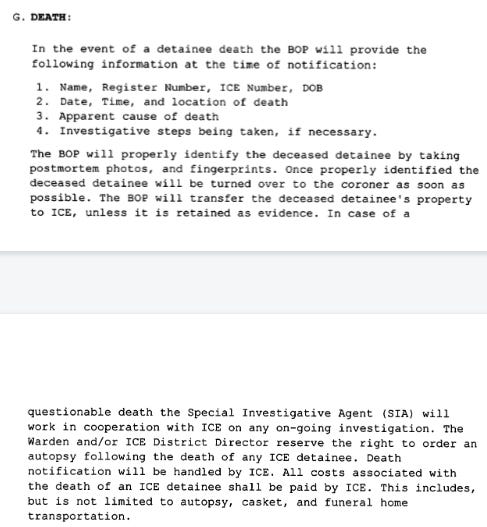
In other parts of the agreement ICE standards and policies, like the 2019 National Detention Standards, are explicitly referenced. Who will investigate this death, and under what standards?
Does the One Big Beautiful Bill Mean No More Death Reports?
As Jacqueline Sweet reports for Newsday, ICE has blown past a federal deadline for reporting the circumstances of the death of Santiago Reyes Banegas on September 18, 2025, in the Nassau County Jail.
Right underneath the part of its Detainee Death Reporting website where the agency says a 2018 congressional mandate requires a death report to be published within 90 days of a person’s death in ICE custody, ICE omits a death report for Santiago.
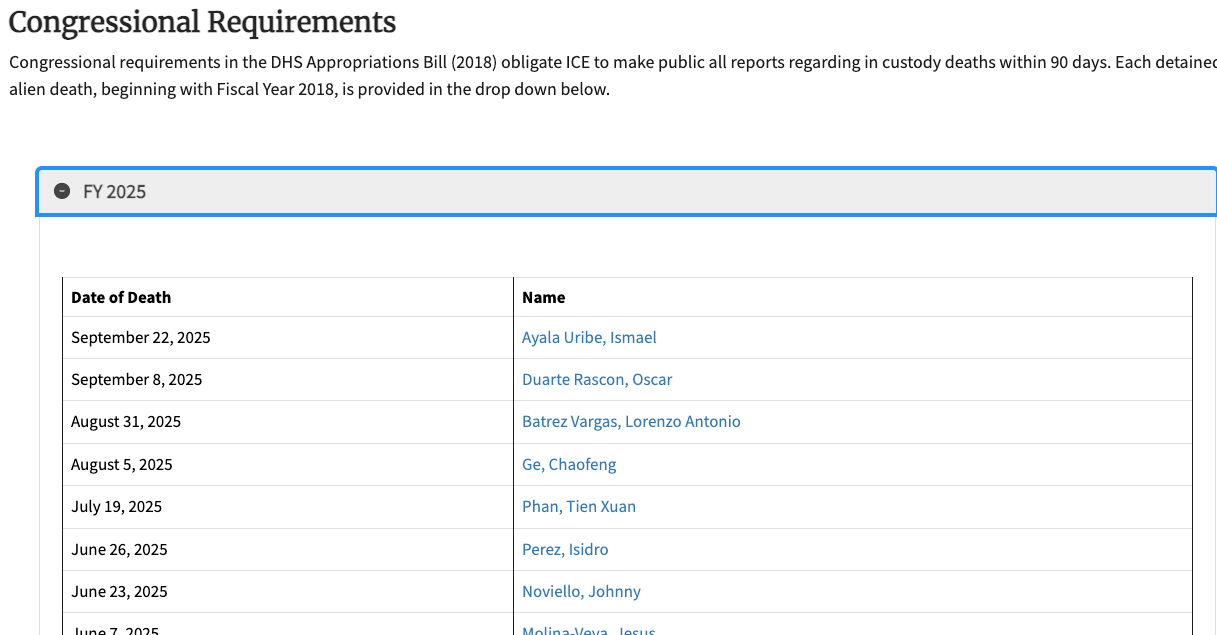
They skip from September 8 to September 22, as though the 42 year-old Honduran father of two children’s death one day after he was arrested never happened at all.
I’ve been asking ICE about this requirement, and whether they still think they’re bound by it going forward. I suspect I’m probably not the only one.
I also have a theory for why. It’s based on the agency’s reported justification for blocking members of Congress from visiting people inside a federal facility in Minnesota earlier today—notwithstanding a federal court order the MOCs attempted unsuccessfully to wield. According to Rep. Ilhan Omar, DHS informed the delegation, effectively, “‘Yes, the law is on your side, but we don’t care, and we are not going to allow you to fulfill your oversight duties.’”
They allegedly cited the One Big Beautiful Bill.
Potentially related, public reporting of the results of ICE Office of Detention Oversight (ODO) inspections, also required by prior appropriations language, appears to have ended in September 2025. And before we attribute the three-month hiatus to the government shutdown, it’s worth recalling that ICE detention centers, transportations, field operations, prosecutions, and deportations were all up and running high-gear during the lapse in federal appropriations. Because those are “essential opetations.” If the shutdown impacted ODO report publication or death reporting, it reflects a decision by top leadership that those aspects of the agency operation are not essential operations.
The alternative explanation, perhaps foreshadowed by the justification MOCs received today for turning a federal civil lockup into a black site cutoff from elected officials and oversight personnel, is that the administration thinks it can use OBBB to essentially ignore or overrule all of the appropriations riders Congress added in an effort to reign the agency in and impose transparency.
First Discrepancy Emerges in Camp Death Timeline
Last night I wrote about the 2nd confirmed death at Camp East Montana. I reported on it last night because that’s when ICE posted its notification, despite its statement that he died January 3—nearly a week before.
Well, I can confirm this evening that the El Paso Medical Examiner apparently recorded the death date of the person who passed away as being January 4, not January 3. When did he die? Where did he die?
When will we know? Who will tell us? Will be able to trust them?