Emergencies
New Reporting on Suicides and Suicidal Ideation in ICE Custody

May 12, 2026
(updated 5:33pm)
“911. What is your emergency”
My latest piece on the April 28 death at Stewart for the Atlanta Community Press Collective is up. In it, I document the delayed emergency response to Denny Adan Gonzalez’s alleged suicide, borne of unclear 911 communications, and a chronic, life-threatening shortage of ambulances in Stewart County. CoreCivic’s Stewart Detention Center has been open in rural Lumpkin, Georgia since 2006. During that time, the County’s child poverty rate has grown as its total population shrunk. As its owners have lined their coffers off the roughly 2,000-bed migrant prison, the economic benefits of the detention center, often framed in terms of jobs and tax revenues, have not translated into sustained net benefits for the residents of Stewart County.
CoreCivic’s extraction of the surplus value of free and nearly-free labor of people inside and precarious, non-union wages for their captors leaves Stewart with just three ambulances to serve the needs of all 5,000 non-detained residents and the nearly 2,000 people locked up inside its detention center. Two ambulances run two-thirds of the time. A third runs one-third of the time. Because the nearest higher-level care facility is in Columbus—at least an hour roundtrip—one call requiring an emergency room visit cuts the county’s capacity to respond to others in half. When both ambulances are in service, a mutual aid agreement with surrounding counties gets triggered.
As Timothy Pratt and I reported for The Intercept last year, this situation became increasingly common last year at Stewart once it filled back up with people.
ICE hasn’t disclosed whether Denny was alive when detention officers found him unresponsive in his solitary confinement cell at 10:26 p.m. If he was, taking twenty minutes to dispatch an ambulance, and having to wait 34 minutes for it to arrive on-site could not possibly have helped his chances at survival.
The neglect at Stewart is structural. Geographic lethality. Which means it’s by design. Small wonder, then, that more people have died at Stewart in the past 10 years than almost any other ICE facility.
The Next to Die
Part of what happens when you document ICE detention deaths is people reaching because they’re in touch with folks inside they believe may be the next to die. Newsday’s Bart Jones has one such story this week. ICE arrested 32 year-old Colombia father Juan Bonilla Lagos in his car with his 5 year-old child while his wife filmed. Juan suffers from diagnosed depression, anxiety, and PTSD. He reportedly attempted to hang himself in an ICE holding cell following his arrest on Long Island, and was hospitalized in New York City for a week following the attempt.

Nonetheless, ICE sent him to its Batavia facility, which is run by the same company responsible for all the preventable deaths in Krome and Camp East Montana - Alaska Native tribal corporation and Akima Global Services. Once there, Newsday guards responded to Juan’s suicidality by placing him naked in a solitary confinement cell, which they’ll likely describe as “medical isolation.” Juan is still alive. For now.
Throughout the detention system there are people like Juan. Those suffering inside the cages while people profit from them. The system could be less deadly and save more lives. It would just cost more. And the system can afford it—ICE is sitting on a multiyear, multibillion dollar slush fund from which it could increase staffing, training, and oversight. But ICE choses not to reduce lethality in the detention system. So someone among the 60,000+ detention population will be the next to die. We just don’t yet know who.
The Adelanto Hole
Adding this important contribution from LAist’s Julia Barajas and (former WABE reporter) Elly Yu. Read it, please.
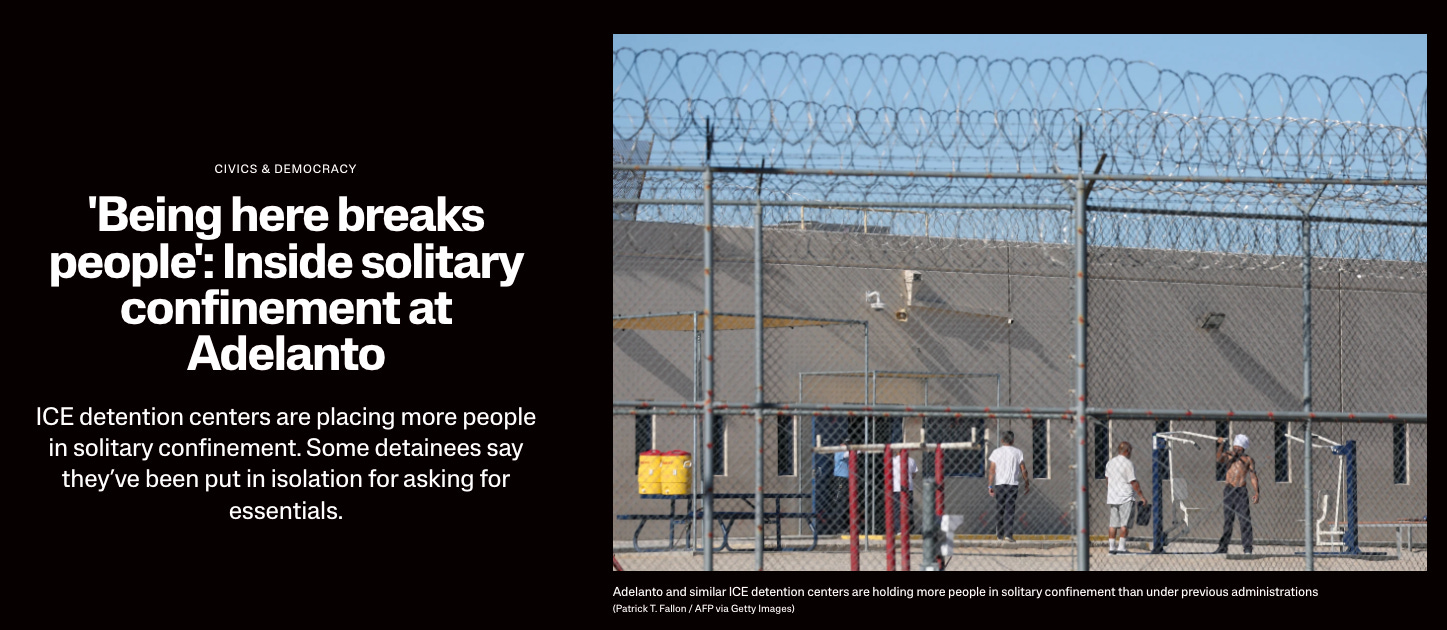
“Geographic lethality” is grim. Structural abuse that evades individual accountability smacks of the banality of evil.