Detention-Attributable
New SF Chronicle ICE Detention Deaths Story Offers Invaluable Contribution to Our Collective Knowledge

April 10, 2026
Happy #FOIAFriday to all who celebrate. Briefly flagging a couple FOIA-nerdy thangs I’ll be noodling on and maybe writing about soon.
First, there’s now a law review article from Narintohn Luangrath about FOIA class actions and the A-File litigation currently pending in N.D. Cal. I haven’t read it yet but it’s on my list.
Second, there’s an absolutely batshit new “thesis” from an ICE statistician at the Center for Homeland Defense and Security at the Naval Postgraduate School in Monterrey, California. As covered in Homeland Security Today, the work, titled “Leaving the FOIA Window Open: Implications for U.S. Homeland Security in the Age of Artificial Intelligence.” ICE’s Simmons is furthering the government’s “mosaic theory” under which it shouldn’t have to release anything protected by an exemption if the aggregation of a bunch of smaller releases with other publicly available data would reveal something the government is allowed to withhold. I also haven’t read it. It’s also on my list. But I hate it. Honestly, I don’t care what the fox wants for dinner. It’s such a revelatory self-own that these folks completely eliminate transparency and accountability from their version of “security.” The latter without the former is anti-democratic and fascistic. FOOH with that.
If ICE wants to use a statistician to do FOIA work, they could use math to figure out ways to comply with the timing provisions of the statute, or to stop thumbing their nose at courts. Instead, they are funding this person’s intellectual sabotage of the statute. If you see this “thesis” cited in any FOIA case, please let me know.
Don’t Read this Post. Read the SF Chron Piece
Yesterday a team of journalists at the San Francisco Chronicle released a groundbreaking new piece of work on deaths in ICE custody under Trump. I don’t wanna tell you what to do, so I’ll kindly suggest that if you’re here, you might stop reading this and go read that.
Part of why this story is so good is that it combines first-person experiences of survivors with official records reflecting part of what happened, then marshals the power of expertise and science, through highly qualified physicians and other experts, to cut through the propaganda and explain exactly why both the government’s fatally negligent care and its flagrantly false stories about that care are two sides of the same coin.
You cannot solve a problem if you do not acknowledge it exists. You cannot prevent deaths where you don’t acknowledge they might have been preventable. The kneejerk, propagandistic conclusion that the person not only should have died, but deserved to die, is a revelation that the system is actually rooting for these killings, rather than trying to prevent them.
“This case is just absolute medical malpractice,” said Dr. Barbara Ogur, an associate professor of medicine at Harvard Medical School who reviewed his treatment records at the Chronicle’s request. - SF Chron piece
The piece replicates (and, through its consistency validates) the death-in-custody tracking we’ve been doing here, later improved upon and published by the UCLA Behind Bars Data Project.
It also offers a really insightful way of measuring rates of mortality.
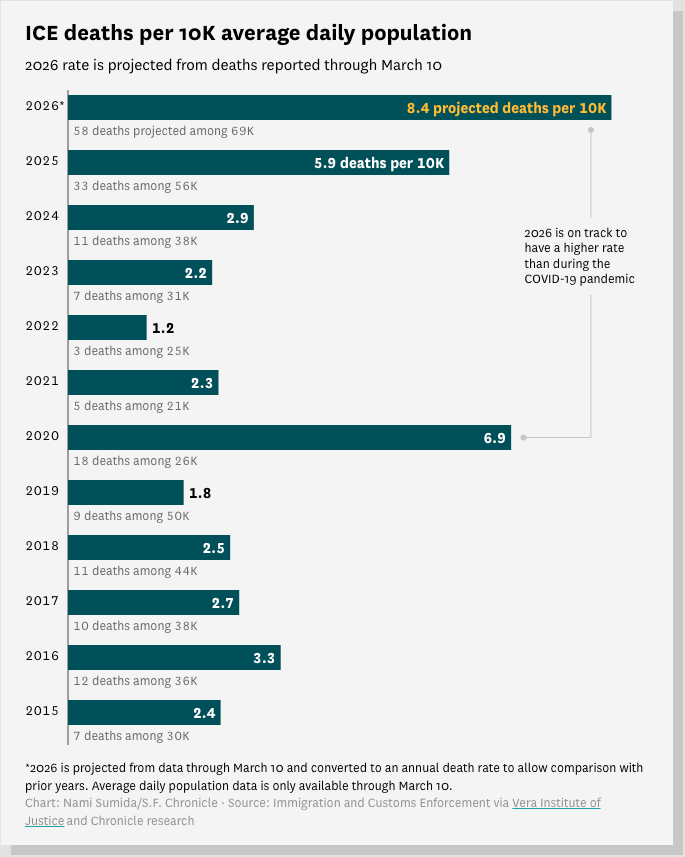
Most important, however, the story connects in a deeply human way with the families of those who passed away, and those released from deadly ICE detention before it claimed their lives.
If you’ve adopted the pivot to video / audio in your news-listening, an interview with two of the piece’s journalists with Austin will be a valuable supplement.

What’s so striking about the work on display in this piece is that it’s necessarily provisional and subject to an even deeper, more damning dive that will come out of the primary source records themselves.
But Dr. Amy Zeidan, an emergency physician and professor at Emory University School of Medicine in Atlanta who was among those who reviewed the detainee death cases, said, “If you're not able to provide quality medical care or let people choose when they need to go to the emergency department, then I don't think you can claim to have appropriate medical care and detain people.”
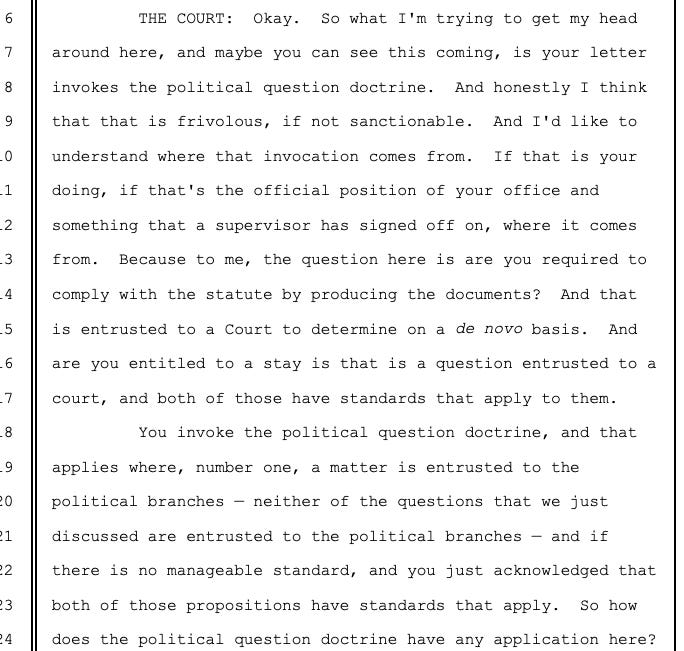
Shutdown, Shutup: “honestly I think that this is frivolous, if not sanctionable”
Only federal FOIA litigation will pry that out of this administration’s hands. So, since it’s #FOIAFriday, let’s see how that’s going under the longest government shutdown in U.S. history.
Anthony Enriquez with RFK Human Rights reports that in a FOIA case out of the Southern District of New York, ICE attempted to tell a federal judge that the government shutdown means he lacked the power to enforce the order he’d previously entered for ICE to produce records. A transcript from the hearing reveals Judge Furman was not amused:
The court then told the AUSA, effectively, to go get his shinebox:
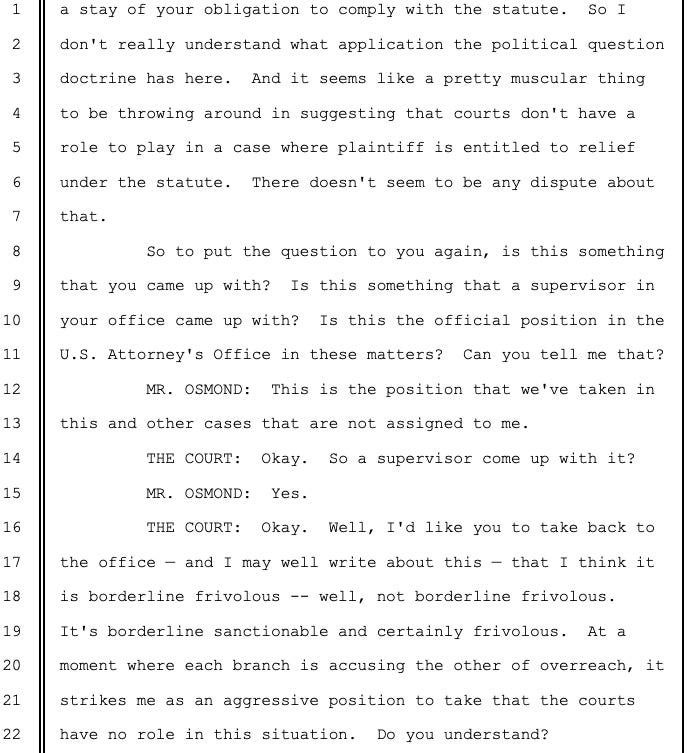
Ooph. “[Go tell your boss this is bullshit]” is about as stern a warning as you’re going to get.
But ICE wasn’t finished.
The agency also pressed its argument that the court’s enforcement of its prior order couldn’t occur because it would violate the Anti-Deficiency Act. That’s the law that prevents the government from spending funds Congress didn’t appropriate, or in ways Congress didn’t allow, and includes potential civil and criminal liability for individual federal employees who violated it.
Trouble is, DOJ and ICE both admitted (outside of court) that the Anti-Deficiency Act doesn’t prevent the executive from taking actions to comply with court orders:
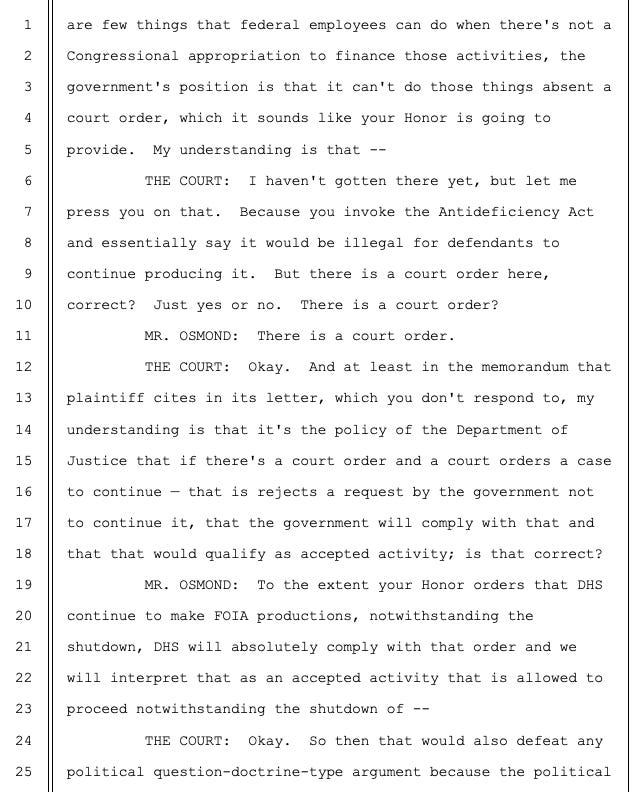
Judge Furman ruled against ICE from the bench. Then he wrote an opinion. ICE lost:
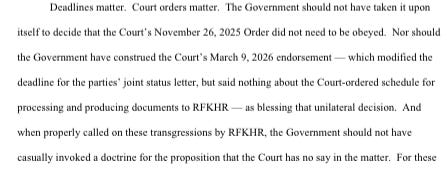
A win against lawlessness and in favor of transparency. Now, on to these stale-ass death record FOIAs.